
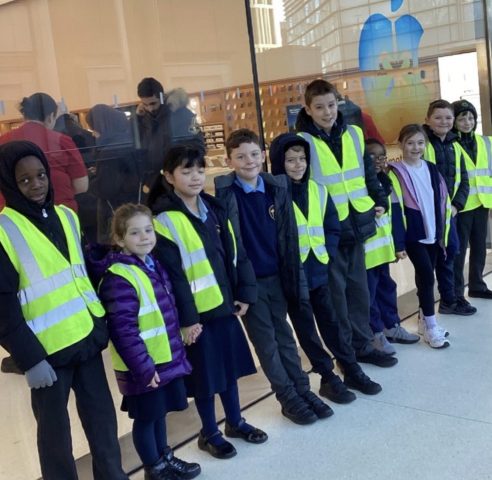
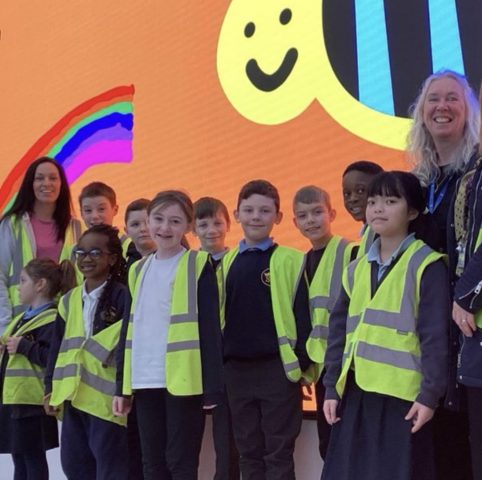
Digital Leaders – Visit to the Apple Store in Liverpool.
Computing Vision Statement
“Everybody should learn to programme a computer, because it teaches you how to think.”
Steve Jobs
Computing is an integral part of our everyday life and will play an immeasurable part in our children’s futures. At our school, we will provide all of our children with the skills, creativity and resilience to live and thrive in a world increasingly dependent on the latest technology. As computing technology underpins today’s modern lifestyle, it is essential that all pupils gain the confidence and ability that they need in this subject to prepare them for the challenge of a rapidly developing and changing technological world.
By the time our children leave our school, we want them to be confident communicators and responsible users of modern technology. We will encourage our children to ask questions and instil curiosity as to how and why things work. We aim to provide our children with a flexible curriculum that fully aligns with the UK National Curriculum across the three core strands: Computer Science, Information Technology, and Digital Literacy so that our children are prepared for the opportunities, responsibilities and experiences of both current and later life. We want to equip our pupils with computational thinking, digital literacy, and problem-solving skills that are needed to understand and change the digital world.
We want our children to use the vibrancy of our great city to learn from other cultures, respect diversity, co-operate with one another and appreciate what they have. We achieve this by providing a strong SMSC curriculum, with British Values and our core values placed at the heart of everything we do. This feeds into the computing curriculum. For example, St Elizabeth’s is one of the thousands of organisations across the UK who enjoy getting involved in Safer Internet Day each year.
Safer Internet Day enables children to make the most of the internet’s potential to bring people together and develop conversations that shape how we talk about and respond to online issues, not just for one day, but throughout the whole year. Last year pupils and staff enjoyed taking part in celebrations and learning based around the theme ‘Too good to be true? Protecting yourself and others from scams online’. Both pupils and staff explored ways to protect themselves and others when online, and they learned about support that is available to them. This year our Safer Internet Day celebrations were led by our school Digital Leaders and they were based around the theme ‘Smart Tech, safe choices – Exploring the safe and responsible use of AI’. Children learned about the impact of AI on all of our lives, looked at how AI can be used for good, and discussed how AI can be used safely and responsibly. We aim for our children to develop skills to keep themselves and others safe when online.
We aim to create a better internet by equipping our children with digital literacy skills and by developing their critical thinking skills, which will allow them to better navigate the online world. They will become empowered to create their own content, make considered choices online, and set a personal example of positive online behaviour. Computing is a diverse subject which is connected throughout the curriculum and can enhance the curriculum being taught in a fun and dynamic way.
We enrich the children’s time in our school with memorable, unforgettable experiences to help learning stick. Last year, for example, our Digital Leaders enjoyed visiting the Liverpool Apple Store where they enjoyed taking part in a digital art and design workshop where they learned how to build skills and bring drawings to life using the Procreate and freeform apps with Apple Pencil. The children later shared their digital creations with their peers at school. We are fortunate to have links and connections with local secondary schools that can give our children access to the latest technology and workshops on how to use it safely and securely. Our curriculum teaches children key knowledge about how computers and computer systems work, and how they are designed and programmed.
By the time the children leave St Elizabeth’s, they will have gained key knowledge and skills in the three main areas of the computing curriculum: Computer Science (focusing on the foundations of how computers and systems work, including creating, following instructions, coding and algorithms), Information Technology (focusing on the use of digital tools and software to create, store, retrieve and manipulate content, including animation and presenting data), Digital Literacy (focusing on responsible, safe and competent use of technology, inluding online safety, positive digital behaviour, critical thinking and looking after physical and mental health online).
The objectives within each strand support the development of learning across the key stages, ensuring a solid grounding for future learning and beyond.
Curriculum Implementation
At St. Elizabeth’s, teachers follow the Purple Mash scheme of work from Year 1 to Year 6. We use this as a starting point for the planning of our computing lessons, which through a connected curriculum are often richly linked to engaging contexts in other topics. There are also cross curricular links to other subjects like maths, English and Science. The scheme is comprised of three aspects: Computer Science, Information Technology and Digital Literacy, which is aligned with the UK National Curriculum and ensures a balanced coverage within the implementation of the curriculum. The children will have experiences of all three strands in each year group, but the subject knowledge imparted becomes increasingly specific and in depth, with more complex skills being taught as the children progress, thus ensuring that learning is built upon.
In Early Years Foundation Stage children’s listening skills, curiosity, creativity and problem solving skills are developed. Children are encouraged to ask questions and explore how things work through play, including role-play. Learning is revisited and often follows children’s interests. Children develop knowledge of sequence by using time connectives when describing events. Children become familiar with equipment through, for example, watching video clips and listening to music. They choose programs and play games on the interactive board enabling them to use information technology purposefully and productively. Children gain knowledge of how to use devices such as Bee Bots that are more widely used in KS1, reducing cognitive load when they come to use them to solve more complex problems. In digital literacy, children explore online safety and they take part in Safer Internet day. Children develop skills in many ways such as through Communication and Language, Understanding the World and Being Imaginative.
In Key Stage 1, the children learn to understand what algorithms are; how they are implemented as programs on digital devices; and that programs execute by following precise and unambiguous instructions. They are taught to create and debug simple programs and use logical reasoning to predict the behaviour of simple programs. They are shown how to use a range of technology purposefully to create, organise, store, manipulate and retrieve digital content as well as recognise common uses of information technology beyond school. They are taught to use technology safely and respectfully, keeping personal information private; identifying where to go for help and support when they have concerns about content or contact on the internet or other online technologies. In Key Stage 2, the children design, write and debug programs that accomplish specific goals, including controlling or simulating physical systems; solve problems by decomposing them into smaller parts. They use sequence, selection, and repetition in programs, use logical reasoning to explain how some simple algorithms work and correct errors in algorithms and programs. Children are taught to understand computer networks, including the internet, and the opportunities they offer for communication and collaboration. They use search technologies effectively, learn to appreciate how results are selected and ranked, and learn to be discerning in evaluating digital content. They use technology safely, respectfully and responsibly; recognising acceptable/unacceptable behaviour; identifying a range of ways to report concerns about content and contact.
Each of these skills are taught through stimulating half termly units via Purple Mash. At the end of each unit, teachers assess which children are working at their year groups expected outcomes and identify those children who are working below or who are exceeding their yearly expectations. Teachers use their judgement to calculate the children’s overall understanding at the end of each academic year.
Staff develop year group specific long-term curriculum maps which identify when the different subjects and topics will be taught across the academic year. Staff make meaningful links across subjects so that we have a connected curriculum. They link prior knowledge to new learning to deepen children’s understanding and to develop skills.
Computing skills are taught discretely and also used to support other areas of learning across the school. Employing cross-curricular links motivates pupils and supports them to make connections and remember the steps they have been taught. Across the school we have two class sets of Chromebooks and one set of Ipads that accompany allocated class Ipads to make a full set. We also have some computers within our classrooms. This is to ensure that children have the opportunity to use a range of devices and programs for many purposes across the wider curriculum, as well as in discrete computing lessons.
Our short-term plans are produced with Purple Mash acting as a supplement for teachers to adapt and utilise the lesson plans to suit the needs of each class. We use these plans to set out the learning objectives for each lesson, identifying engaging activities and resources which will be used to achieve them. We adhere to teaching a weekly computing lesson. This helps to ensure sufficient time is allocated to computing and that computing subject matter can be revisited frequently. We believe that by crafting our curriculum this way, we improve the potential for our children to retain what they have been taught, to alter their long-term memory and thus improve the rates of progress they make.
Curriculum Impact
Our Computing curriculum is high quality, well thought out and is planned to demonstrate progression. We use both formative and summative assessment information in computing lessons, which staff then use to inform their short-term planning. This helps us provide the best possible support for all of our children, including challenging the more able. The objectives in each unit are carefully mapped out and broken down into individual lessons for each year group. This means that skills in computing are progressive and are built upon as they advance through school.
The Purple Mash Computing scheme of work provides structured progression of skills and knowledge through to year six and it is fully aligned with links to the national curriculum. Computing Science – Moving from understanding simple instructions to sequence, selection, repetition, variables, debugging, external device control (e.g. micro:bit) and text based coding via Python in Pieces. Information Technology – Evolving from basic mouse, touchpad and keyboard navigation to digital art, story animation, music creation, spreadsheets, databases, 3D modelling and industry standard tools. Digital Literacy and Online Safety – Progressing from safe device usage and recognising online concerns to critical evaluation of online information, copyright, digital footprint management and mental/physical well-being online.
Our staff use a range of formative assessment methods to assess what the children know as the topic progresses and inform their future planning. These formative assessment strategies then inform summative assessment judgements for each unit and an overall judgement can be made at the end of the academic year based on the information gathered.
Children are assessed on the skills they have learned in conjunction with the objectives they have achieved in each unit. The quality of the children’s learning is evident on the Purple Mash Excel assessment document where teachers can monitor children’s progress and learning. Evidence of this is used to feed into teachers’ future planning in order to bridge those gaps to enable the children to progress. This may be implemented in a cross-curricular way, or built upon in a discrete computing lesson. The assessment information is monitored frequently by the Computing Co-ordinator and analysed to ensure children are making progress. This process provides a comprehensive understanding of the quality of education in Computing. All of this information is gathered and reviewed and CPD sessions have been conducted for all teachers in order to enhance qualify first teaching.
After the implementation of this robust computing curriculum, children at St Elizabeth’s will be digitally literate and able to join the rest of the world on its digital platform. They will be equipped with the skills and knowledge to use technology effectively, for their own benefit and most importantly, safely. We want on our children to understand the consequences of using the internet and we want them to be aware of how to keep themselves safe online so that they can protect their well being. After completing the Purple Mash scheme of work children will have progressed from play based digital exposure to a comprehensive set of skills spanning Computer Science, Information Technology and Digital Literacy. As children become more confident in their abilities in computing, they will become more independent and develop key life skills such as problem-solving, logical thinking and self-evaluation which will become second nature. Computing at St Elizabeth’s gives children the building blocks to enable them to pursue a wide range of interests and vocations in the next stage of their lives.
Computing Curriculum Map 2026-2027